
Momentum Just Flipped
Bitcoin is no longer in a strong bearish regime

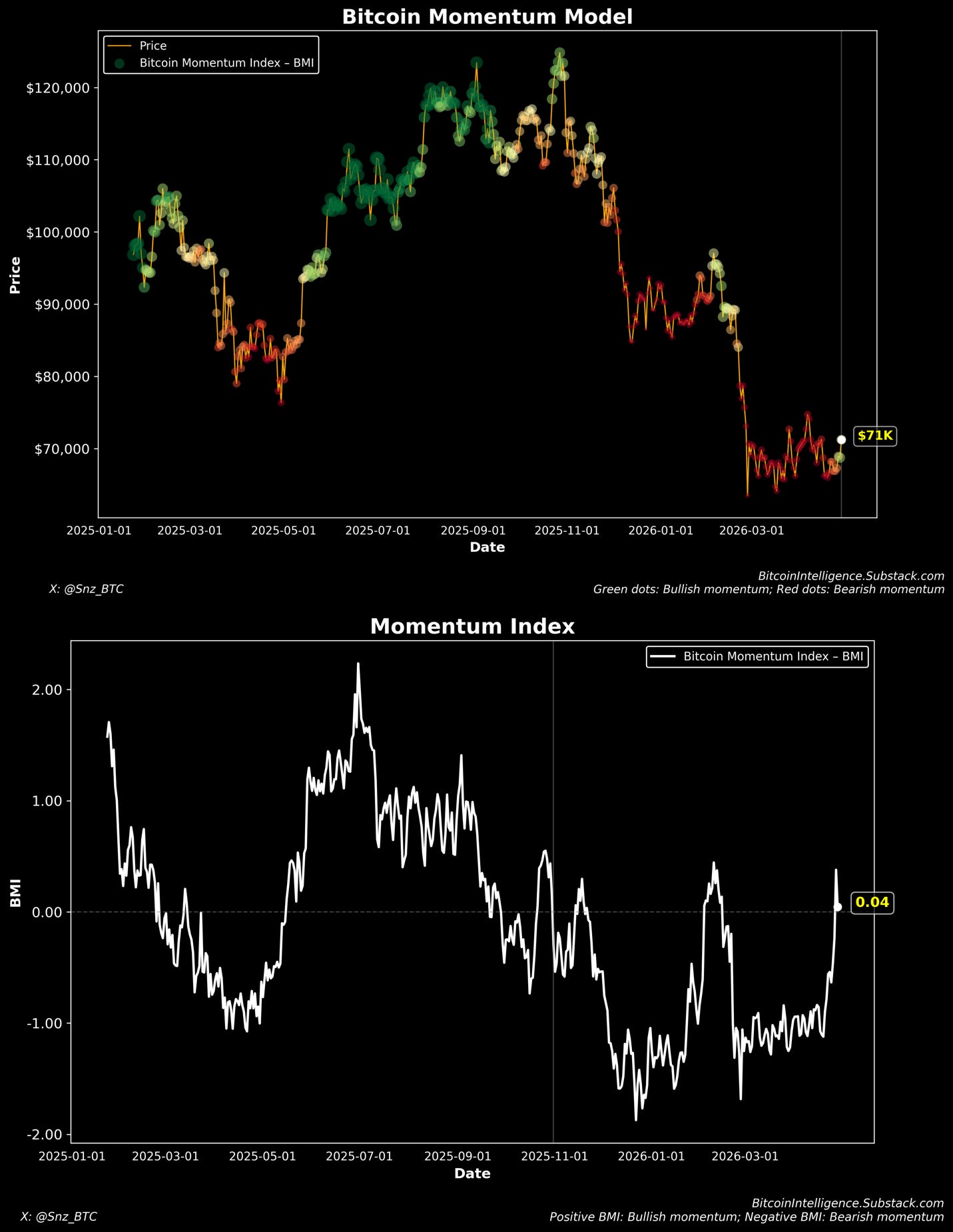
Introduction
Hello Bitcoiners!
Momentum has just flipped. Over the past few weeks, Bitcoin has continued doing what weak markets often do near turning points: chop excruciatingly, shake people out, and maximize pain before the real pump.
After a gradual macro recovery, the Iran war was a wrench thrown at Bitcoin recovery and kept it in the chop land for a few more weeks. But signs of a temporary ceasefire will inject lots of optimism and allow the fundamentals to finally work. To be clear, we have a lot to learn about this ceasefire. It is very unlikely that the IRGC will surrender. So unless Trump eases demands or completely decapitates them to the point of demise, no real deal is in sight. The current ceasefire talks could very well be just an attempt to calm the markets before another round of bombing.
Nevertheless, Bitcoin has been resilient recently and is slowly building stronger and stronger momentum. Price is now back around $71K, and after spending a long stretch in deep bearish territory, momentum has finally climbed back to the edge of neutral.
If you have been following our reports, you know we have been waiting for this moment. Our fundamental reports had highlighted an improvement in the macro backdrop. But the negative momentum had kept us out and led us to believe we are in a bearish regime.
Not anymore. We are back above the momentum waters.
The Bitcoin Momentum Model converts recent price action into a simple regime signal: bullish when momentum is positive, bearish when it is negative, and neutral when it is near zero. The point is not to call exact tops and bottoms. The point is to manage risk by staying exposed during sustained uptrends and getting defensive during sustained downtrends. In practice, green means add or hold risk, red means reduce risk or avoid adding, and near-zero means be cautious and avoid overreacting.
In this article, we provide an update as of April 7, 2026.
Momentum has improved sharply
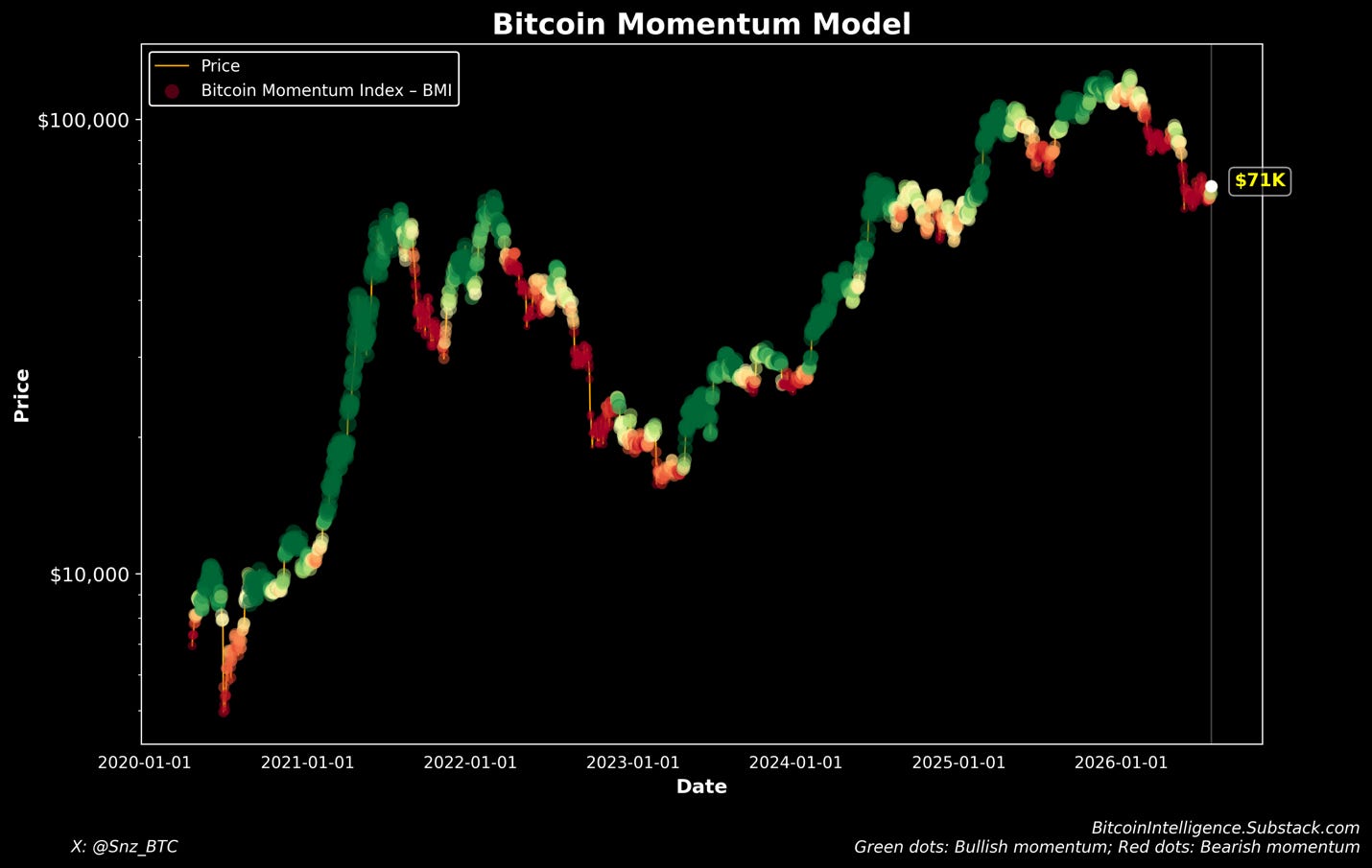
Bitcoin is currently around $71K, and the momentum model is no longer flashing deep red. Instead, it has recovered all the way back to the edge of neutral, with the latest BMI reading at roughly 0.04.
This indicates Bitcoin is currently in a neutral to very slightly positive momentum state.
That is a notable change from late March. Back then, momentum was still clearly bearish and remained well below zero. Since then, price has held the lower range, avoided fresh breakdowns, and managed to rebuild enough short-term strength for the momentum index to claw its way back to neutral.
That said, one slightly positive reading does not automatically mean a durable bull regime has begun. It means conditions have improved materially, but confirmation still matters.
A closer look: momentum has recovered, but the structure is still fragile
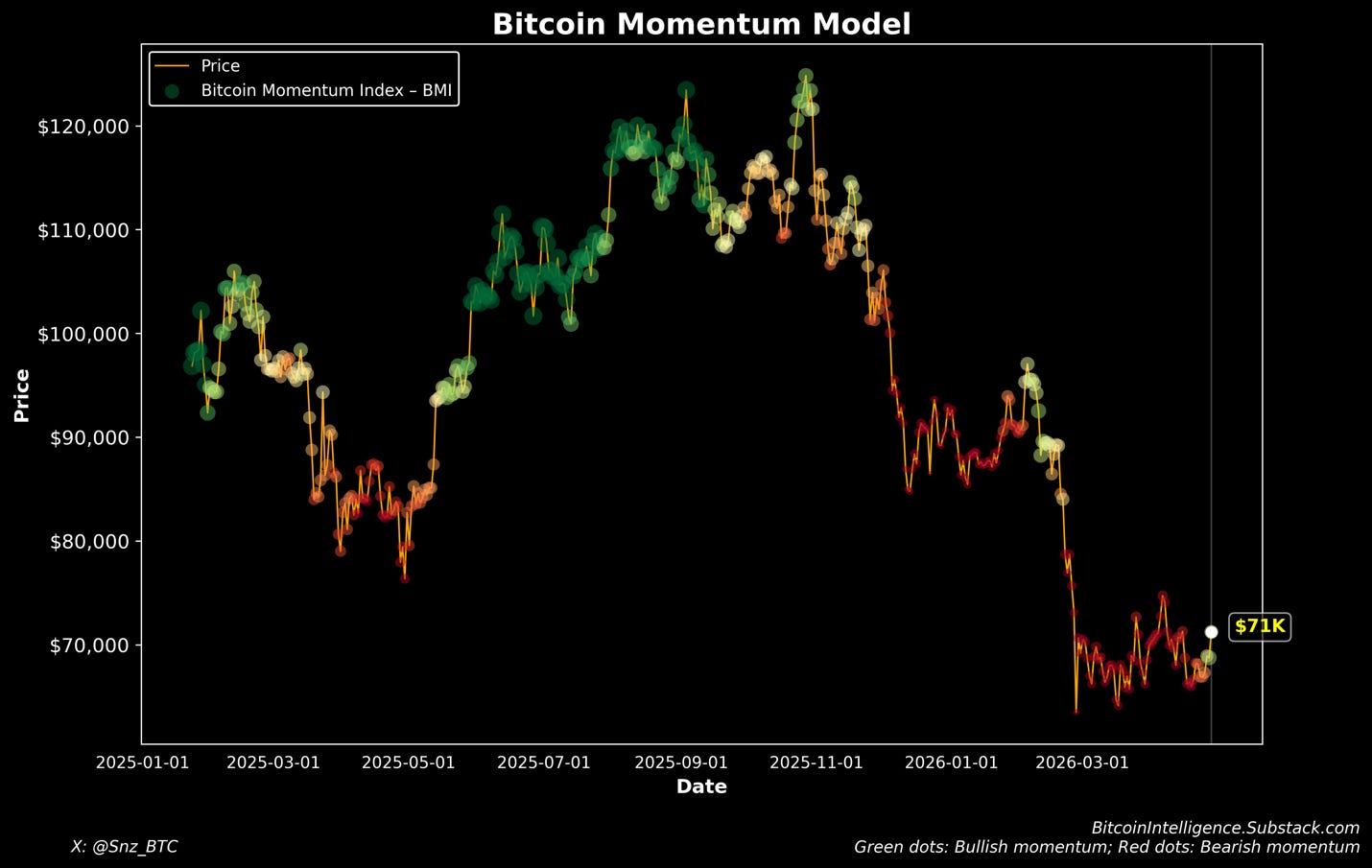
Here is a closer look at the last year.
The chart shows the story clearly. Bitcoin peaked late in 2025, rolled over, and then spent months in a weak regime marked by failed rallies, sharp drops, and repeated losses of trend strength. That prolonged deterioration pushed momentum deeply negative.
What has changed is that the market has finally spent enough time stabilizing for momentum to recover from deeply bearish levels. That is the first step.
If Bitcoin can continue holding this range, avoid another major breakdown, and keep building strength, this neutral reading can turn into a real bullish regime.
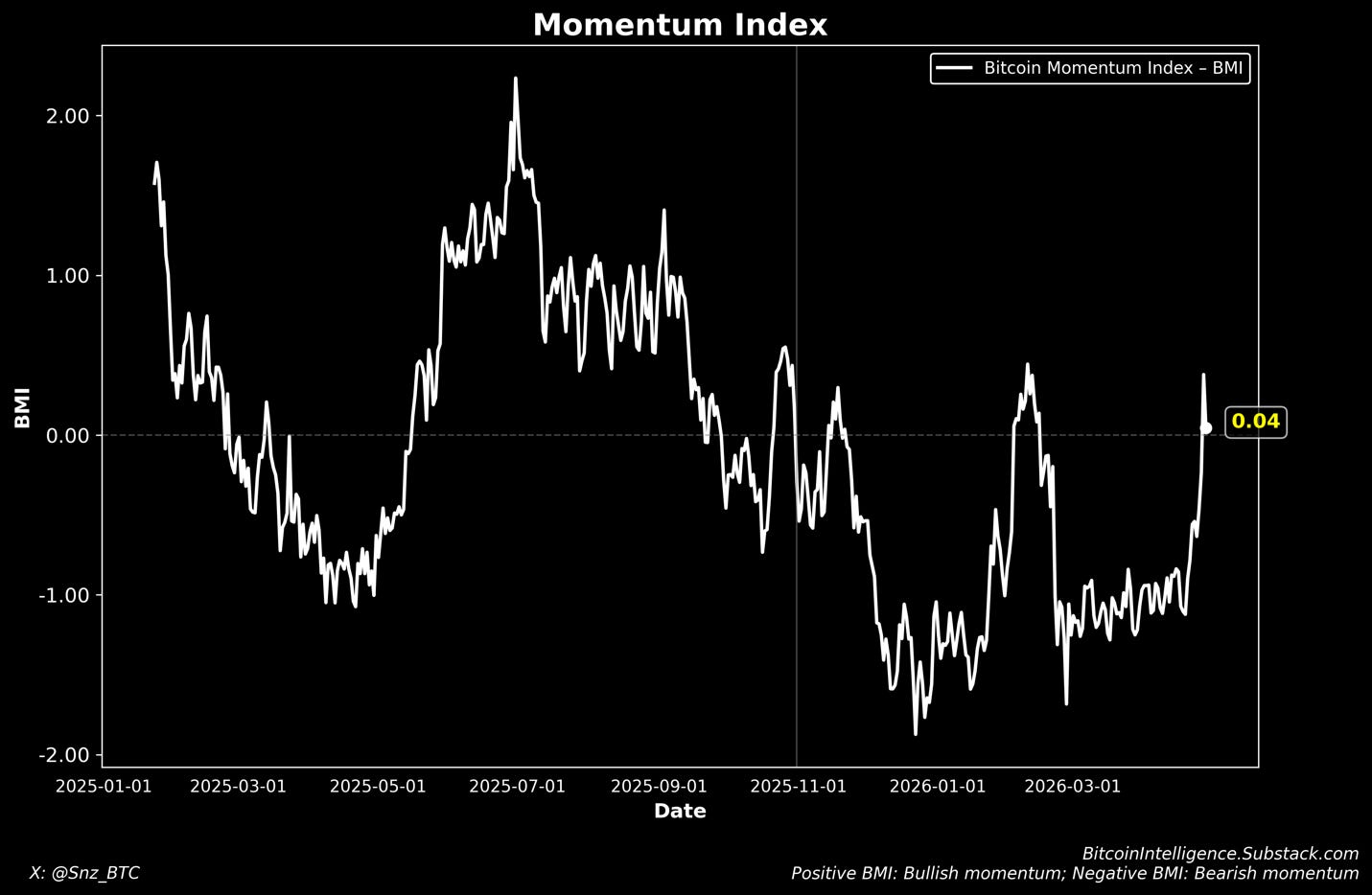
The current momentum index reading is 0.04.
That is a big improvement from the deeply negative readings we saw over the last few months. In other words, momentum has not merely bounced a little. It has undergone a meaningful recovery.
A reading just above zero tells us bearish momentum has largely been worked off. It tells us downside pressure is no longer dominating the market in the same way it did earlier this year. But it does not yet tell us a strong upside trend is firmly in place. We are in the transition zone.
The index signals a transition
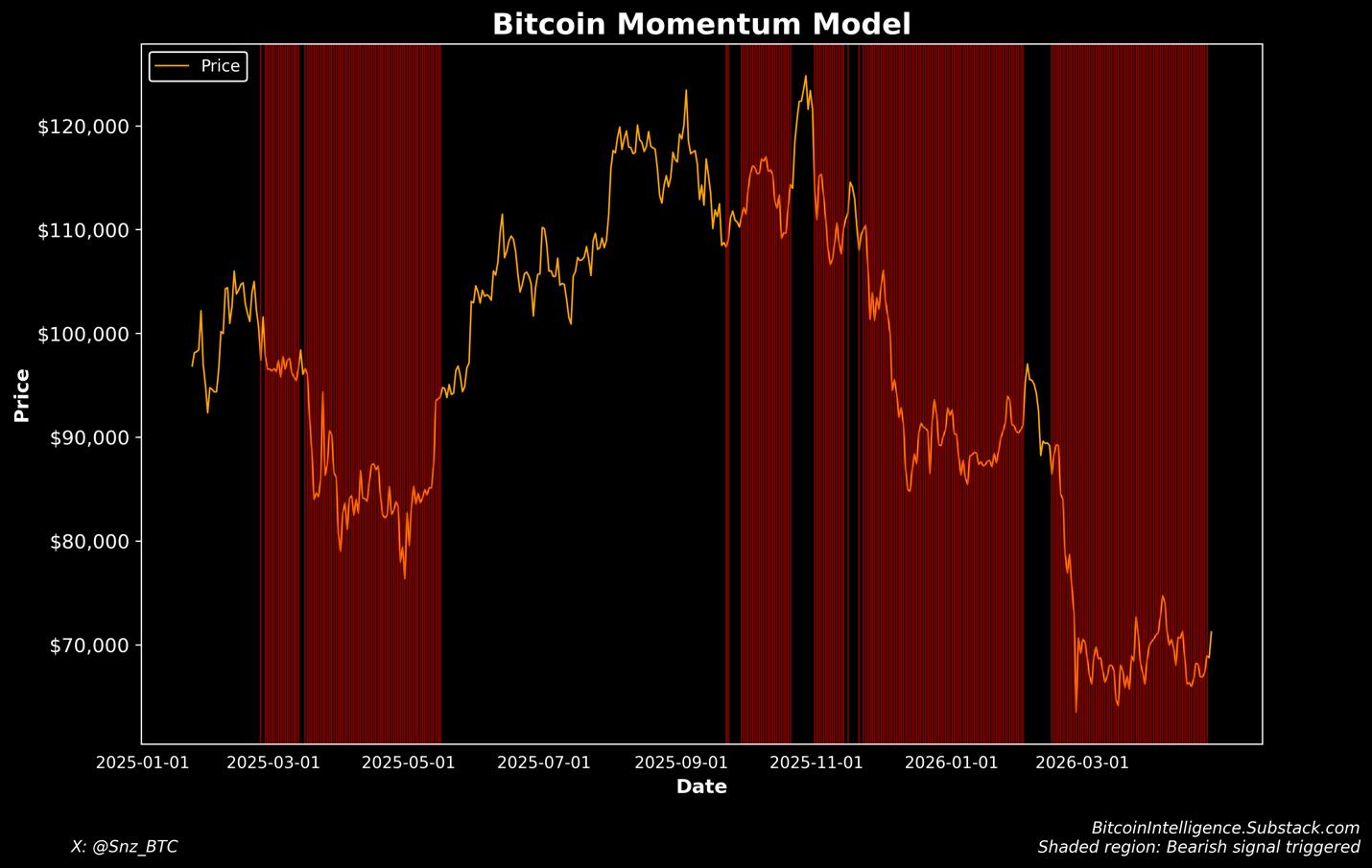
The shaded history remains useful here.
Looking back, the model effectively shifted to defense around September 2025, when Bitcoin was roughly in the $110Karea, and it stayed broadly bearish through the long deterioration that followed. There were a few fake-outs and brief countertrend recoveries, but the broader regime remained defensive. That is exactly the kind of behavior the model is designed to capture.
Now, for the first time in a while, we are seeing the bearish shade has ended.
That is the best development we have seen in months.
So our stance now is more balanced than in March:
The deep bearish phase has improved significantly,
The momentum index has recovered to neutral/slightly positive,
But the model is still in a watch-and-verify stage rather than a high-conviction bullish one.
Long-term perspective
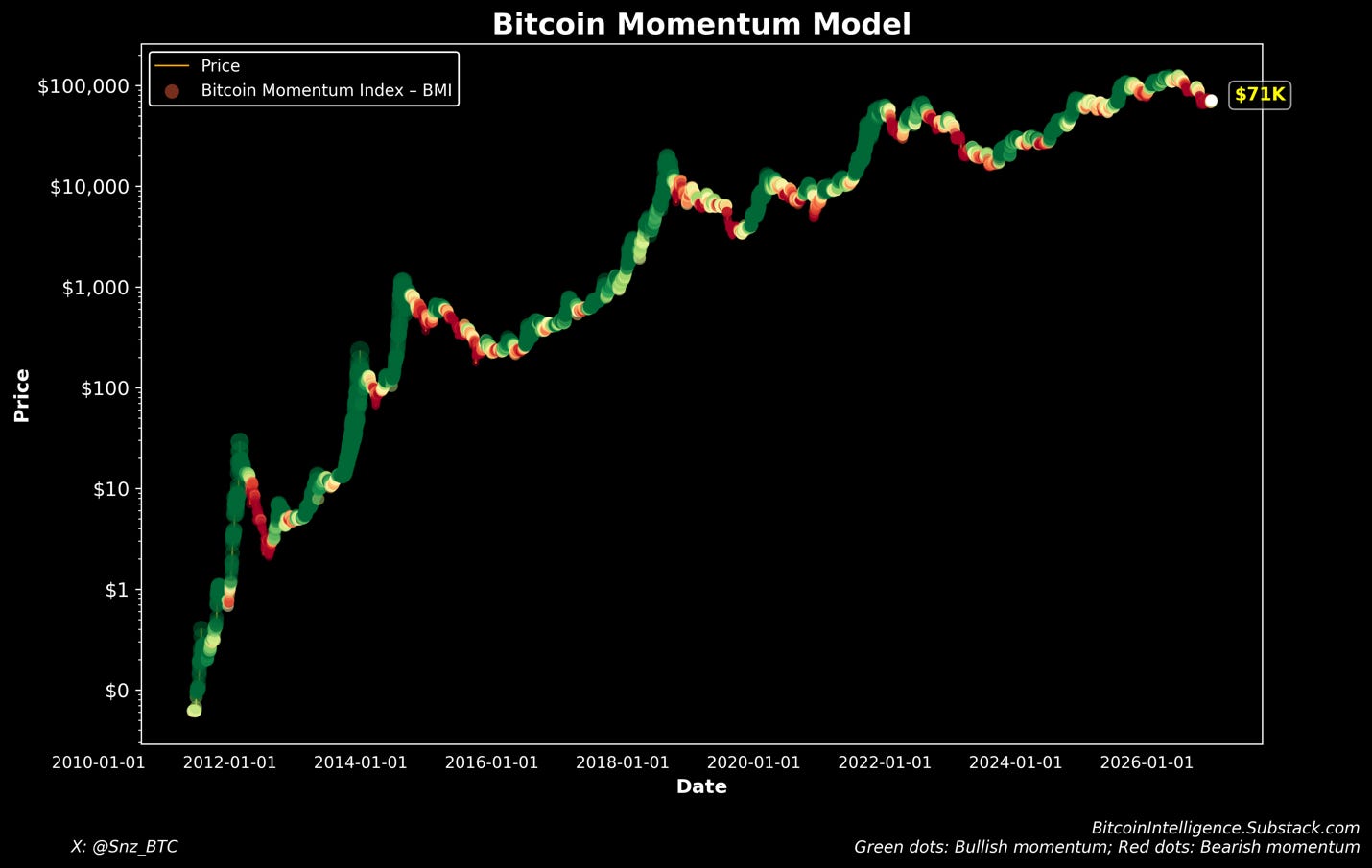
The full-history chart helps put the current setup in context.
Across Bitcoin’s major cycles, the model has generally done what a momentum framework should do: stay green during sustained advances, turn red during prolonged deteriorations, and wobble around turning points when the market is transitioning from one regime to another.
Turning points are messy. They are rarely clean reversals. Usually they involve sharp rebounds, hesitation, and several attempts before a real trend becomes obvious. That is why we are cautiously optimistic.
Historically, what has mattered most is not the first touch of the zero line. It is whether momentum can stay on the right side of it and build from there.
That is what we are watching now.
Conclusion
The Bitcoin Momentum Model has improved materially since the last update.
Bitcoin is around $71K, and the BMI is now 0.04, meaning momentum has recovered from deeply bearish territory back to neutral and slightly positive. That is the strongest sign of stabilization we have seen in some time. But this is still a transition, not a clean bullish regime.
The model is telling us the bear trend has weakened substantially. It is not yet telling us a strong new bull regime is fully in place. For that, we need persistence. While we wait for the market to prove itself, we are excited that momentum has recovered so much.
See you in the next update.
Sina
____________________________________________
Appendix: What is the Bitcoin Momentum Model
The Bitcoin Momentum (BM) model is a systematic framework that turns recent Bitcoin price action into a practical risk-management signal – helping you recognize regime shifts, reduce exposure during prolonged bearish periods, and stay invested during sustained uptrends.
Our introductory piece motivated why momentum is especially powerful in Bitcoin and how the model operationalizes it. It defined momentum as the tendency for trends to persist, strength leading to further strength, and weakness leading to further weakness, and argues Bitcoin is unusually momentum-driven because it lacks traditional valuation anchors, trades 24/7 in a globally speculative market, and is amplified by leverage and reflexive flows (rising prices pull in demand; falling prices suppress it).
The Bitcoin Momentum Index (BMI): the model generated a momentum score computed from the last several months of price action, with added safeguards to reduce short-term noise. On any day, BMI is calculated using only information available up to that date (no lookahead), and the output is framed as bullish (positive), bearish (negative), or transition/neutral (near zero)—visually shown as green/red/white-ish zones.
Historically, BMI stayed positive through most bull phases and negative through most bear phases, so following it would generally keep you in during “good times” and out during “bad times,” without pretending to nail exact tops/bottoms.
We illustrated its behavior in real time by highlighting a recent crash example: BMI flipped from positive to negative on October 10 (the same day the bear phase began), after momentum had already weakened from September 1, with some brief “fake-out” signals that corrected quickly.
The intended takeaway from this research is the model provides “protection”: treat negative BMI as a prompt to take precautions (trim exposure, reduce allocation, hedge, avoid leverage), not as a guarantee that a crash must happen, and optionally require confluence with a second signal to reduce false positives.
Introductory article: