
Macro Data is Becoming Interesting Again
We are observing the early indications of a potential reversal

We have spent the past several editions focused on Bitcoin’s internal dynamics. The takeaway from the last article was that momentum is still negative and Bitcoin is still not ready for a trend change. In line with that view, Bitcoin’s price remained largely subdued.
Today we note that macro data are becoming interesting again, and the latest reports are beginning to send an important signal. June inflation came in well below expectations, while the labor report showed weak job creation and a sharp decline in labor force participation. Neither report alone establishes a new trend. Taken together, however, they suggest that the economy may be losing momentum while inflation remains unusually sensitive to energy shocks. This edition examines what the inflation and labor data mean for the Federal Reserve, the economy, and Bitcoin.
This month’s data was an appetizer. If the same trend is observed in the next reports, Bitcoin’s bear market will come to an end. If inflation keeps cooling, rate hike expectations will get crushed, and if AI proves to be actually killing jobs at the aggregate, QE expectations will rise. This will lead to a rapid repricing of Bitcoin from an extreme low. However, this all depends on confirmation of what we saw this month. We will continue to monitor the data. In the next article, we will revisit Bitcoin’s price momentum to also get a sense of how the macro climate is showing up on the chart.
Inflation
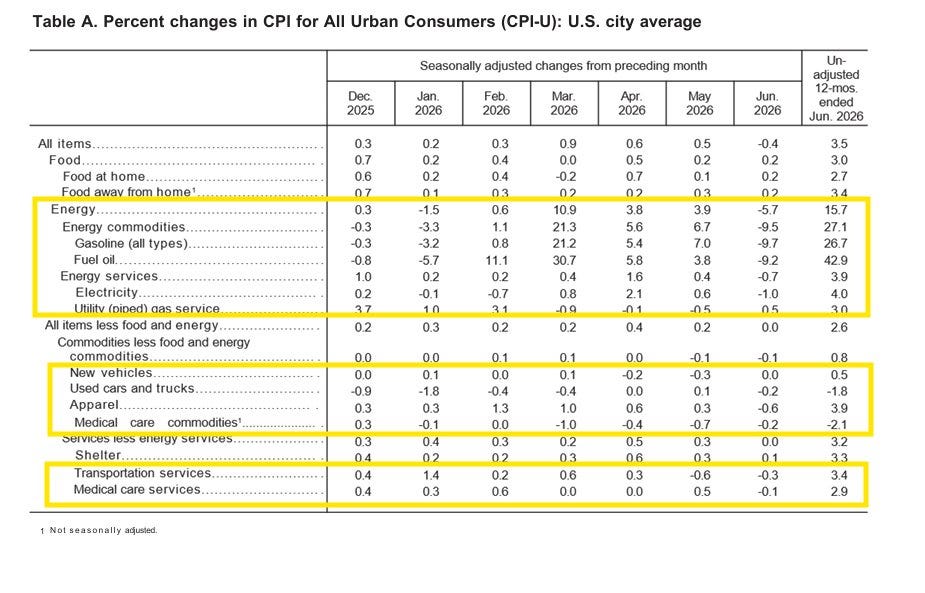
Inflation cooled much more than expected in June. Headline CPI fell 0.4% from May, the largest monthly decline since April 2020. The year-over-year rate dropped to 3.5% from 4.2%. Energy was the main driver. Energy prices fell 5.7% during the month, while gasoline fell 9.7%.
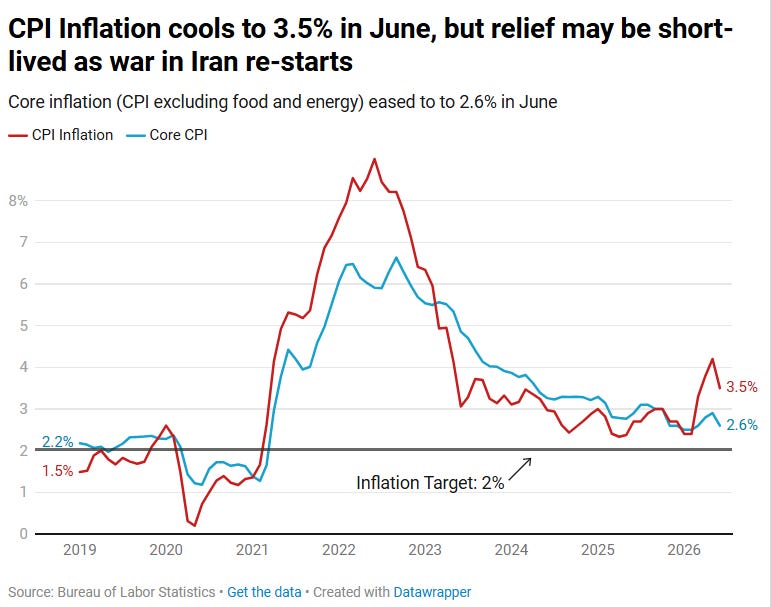
The improvement was broader than energy alone. Core CPI was unchanged in June, and the 12-month core rate fell to 2.6% from 2.9%. Prices declined for used cars and trucks, apparel, medical care, communication, and motor vehicle insurance. Shelter and food still increased, so the report does not show broad deflation. It does show that underlying price pressure weakened materially once the energy shock eased. Renewed conflict involving Iran could lift oil and transportation costs again. June therefore gives the Fed breathing room, but not a clean victory over inflation.
Fed Funds Rate Outlook
Markets quickly reduced expectations for near-term rate increases after the CPI release. CME FedWatch assigns an 84.5% probability that the Fed will hold rates steady at its July meeting. That probability was 58.3% before the inflation report.
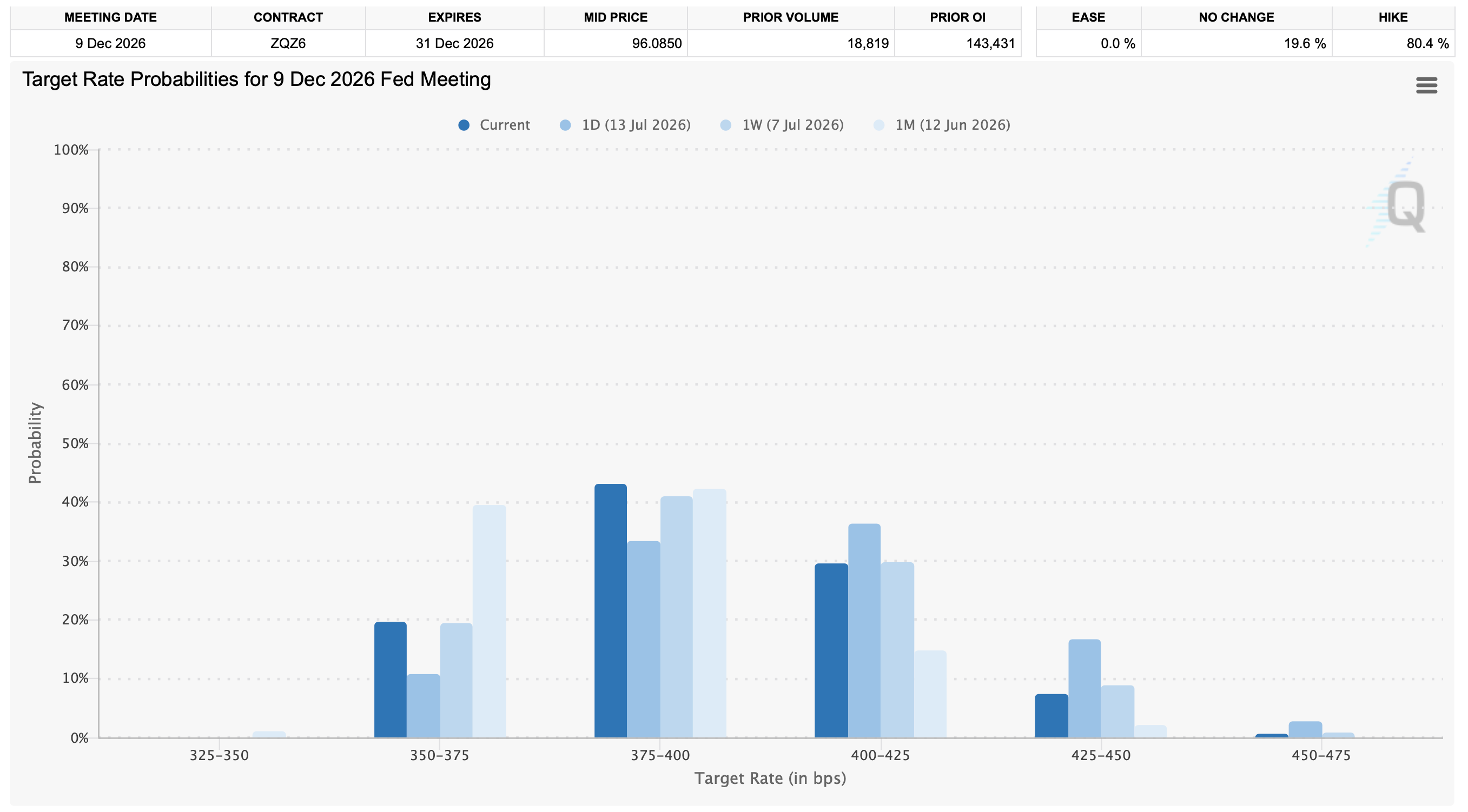
The Federal Reserve currently targets a federal funds rate of 3.50% to 3.75%. The market reaction is not a shift toward rate cuts. It is a reduction in the probability of additional tightening.
For year-end, the distribution shown in the chart remains centered on one 25 basis point increase. The probability of one hike is about 43%. The next most likely outcomes are two hikes at about 29% and no hikes at about 19%. The key change is that markets now see less need for aggressive tightening after the softer inflation report.
Labor Market
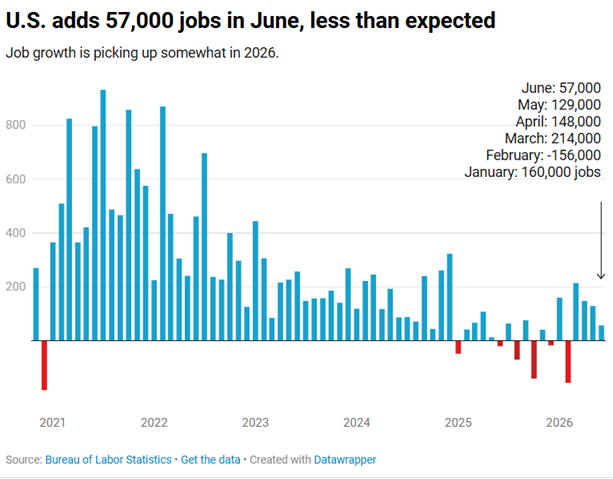
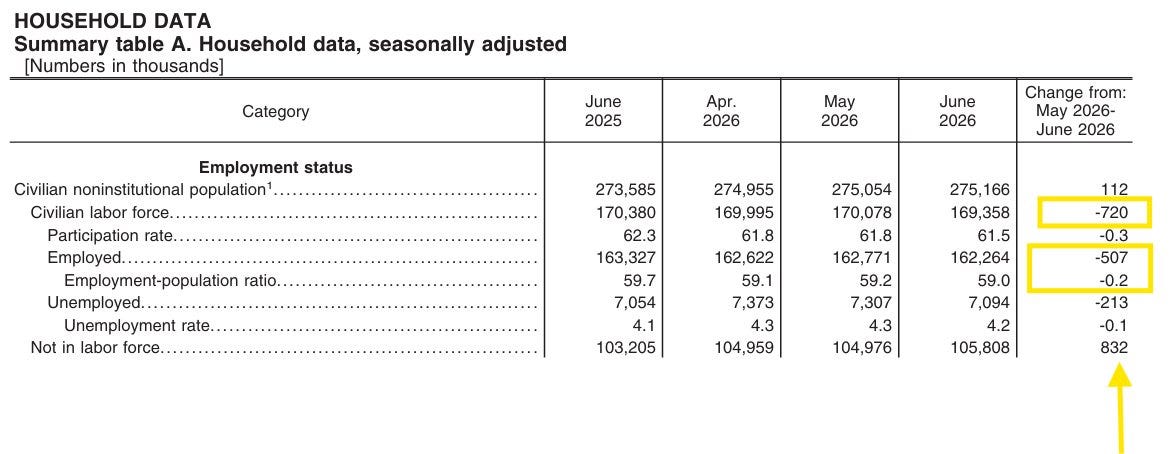
The June employment report was weaker than the headline unemployment rate suggests. Employers added 57,000 jobs, well below the 115,000 consensus estimate. April and May were revised down by a combined 74,000 jobs. The unemployment rate edged down to 4.2%, but the labor force contracted by 720,000 people and household employment fell by 507,000. Average hourly earnings increased 3.5% over the year, which matched the June headline inflation rate rather than clearly exceeding it.
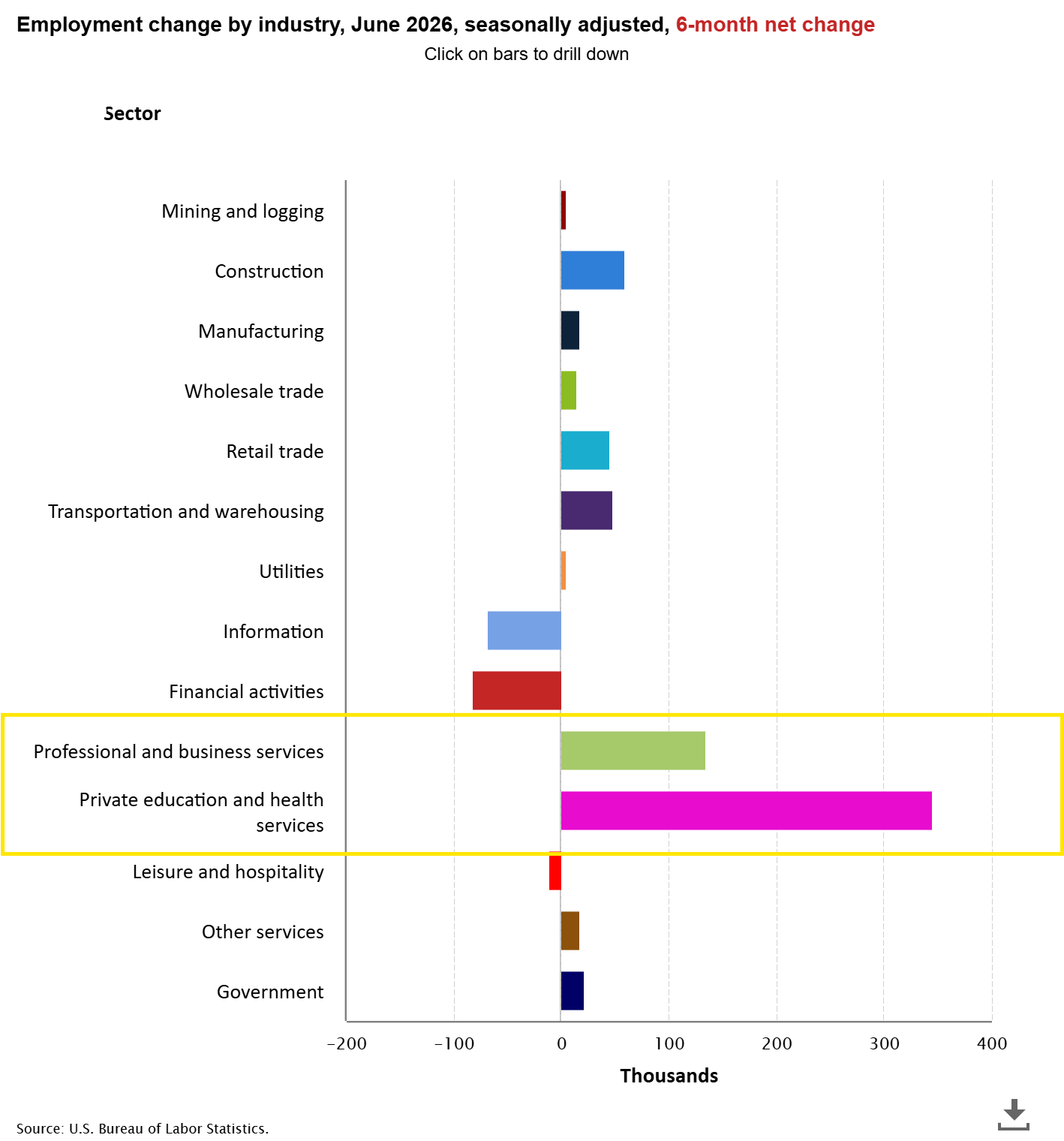
Job growth was also narrow. Professional and business services added 36,000 jobs, social assistance added 25,000, and health care added 22,000. Leisure and hospitality lost 61,000 jobs, while most other major industries changed little. The report is not a collapse. Payroll growth over the prior 12 months averaged only 36,000 per month, so June fits a weak but stable trend. That may be acceptable for the Fed, but it remains a difficult labor market for job seekers outside a few expanding sectors.
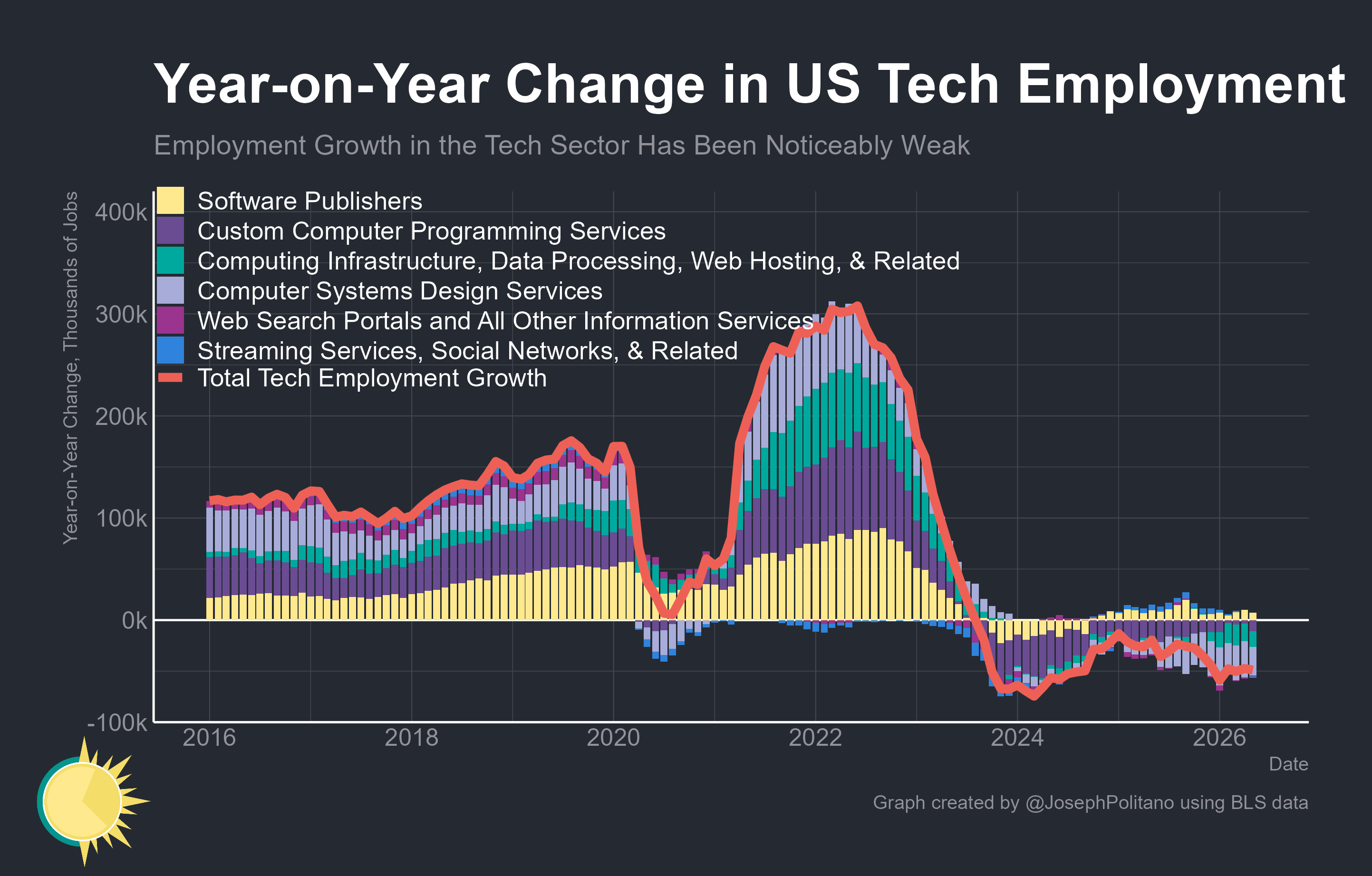
The weakness becomes more striking when we look at technology. The tech employment measure shown below is down about 49,000 jobs from a year earlier. AI is likely part of the explanation, but it is not the only one. Firms are directing capital toward data centers, chips, and software while trying to produce more with fewer workers. The employment data cannot separate the AI effect from post-pandemic overhiring, higher financing costs, and broader cost cutting.
The current year-over-year decline in technology employment is close to the trough reached during the 2024 tech contraction. It is also larger than the declines shown around the 2008 and 2020 recessions. This matters because technology often leads broader changes in business investment and white-collar hiring. A continued slide would suggest that strong AI investment is not translating into broad employment growth.
Unemployment
The unemployment rate fell to 4.2%, its lowest level in a year. Normally, that would be welcome news. This time, the decline came with clear signs of labor market contraction. The labor force fell by 720,000 people, and household employment dropped by 507,000. The employment-to-population ratio declined to 59.0%, its lowest level since 2021. The overall participation rate also fell by 0.3 percentage point to 61.5%.
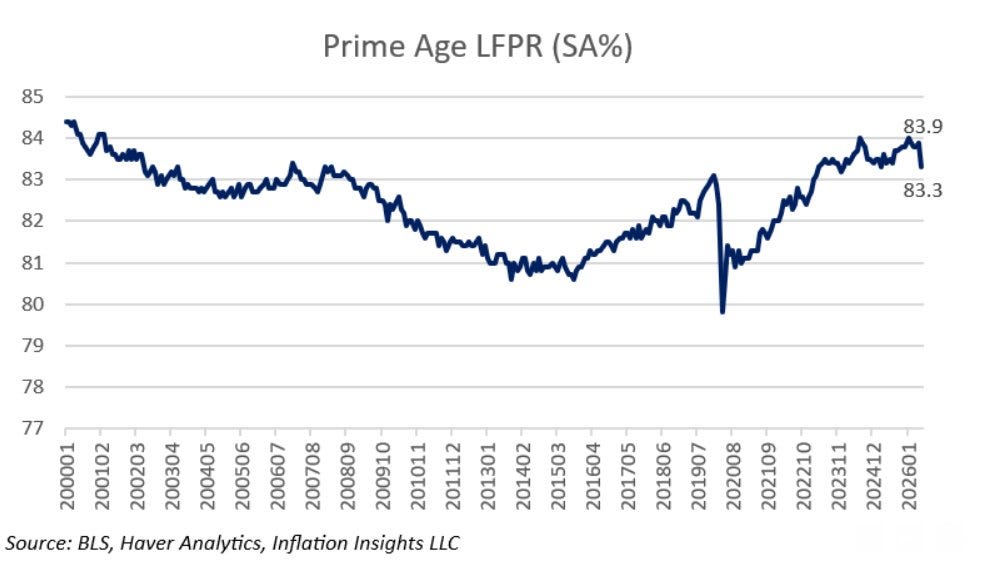
Prime-age participation was another warning sign. The rate for workers ages 25 to 54 fell from 83.9% in May to 83.3% in June. A monthly decline of 0.6 percentage point is unusually large outside the pandemic period. One month can be noisy, but this measure is important because it is less affected by retirement and school enrollment than the overall participation rate.
Conclusion
