
Early Signs of Stabilization
Several indicators show that the market is changing

After quite some time, I am seeing early signs of things changing for Bitcoin.
Change in the macro climate, price chart, futures positioning, and momentum.
On November 13, 2025, we published an article arguing that Bitcoin’s selloff was not primarily a Bitcoin-specific event, but a liquidity event. At the time, we showed that one of the clearest signals came from short-term funding markets, especially the behavior of SOFR and its spread versus EFFR. Our core finding was that the SOFR–EFFR spread turning positive and funding stress intensifying led to the violent Bitcoin sell-off in late 2025 (in line with other liquidity-sensitive assets). This finding suggested the correction was being driven less by structural weakness in Bitcoin itself and more by tightening conditions in the plumbing of the financial system.
See a screenshot below from that article.
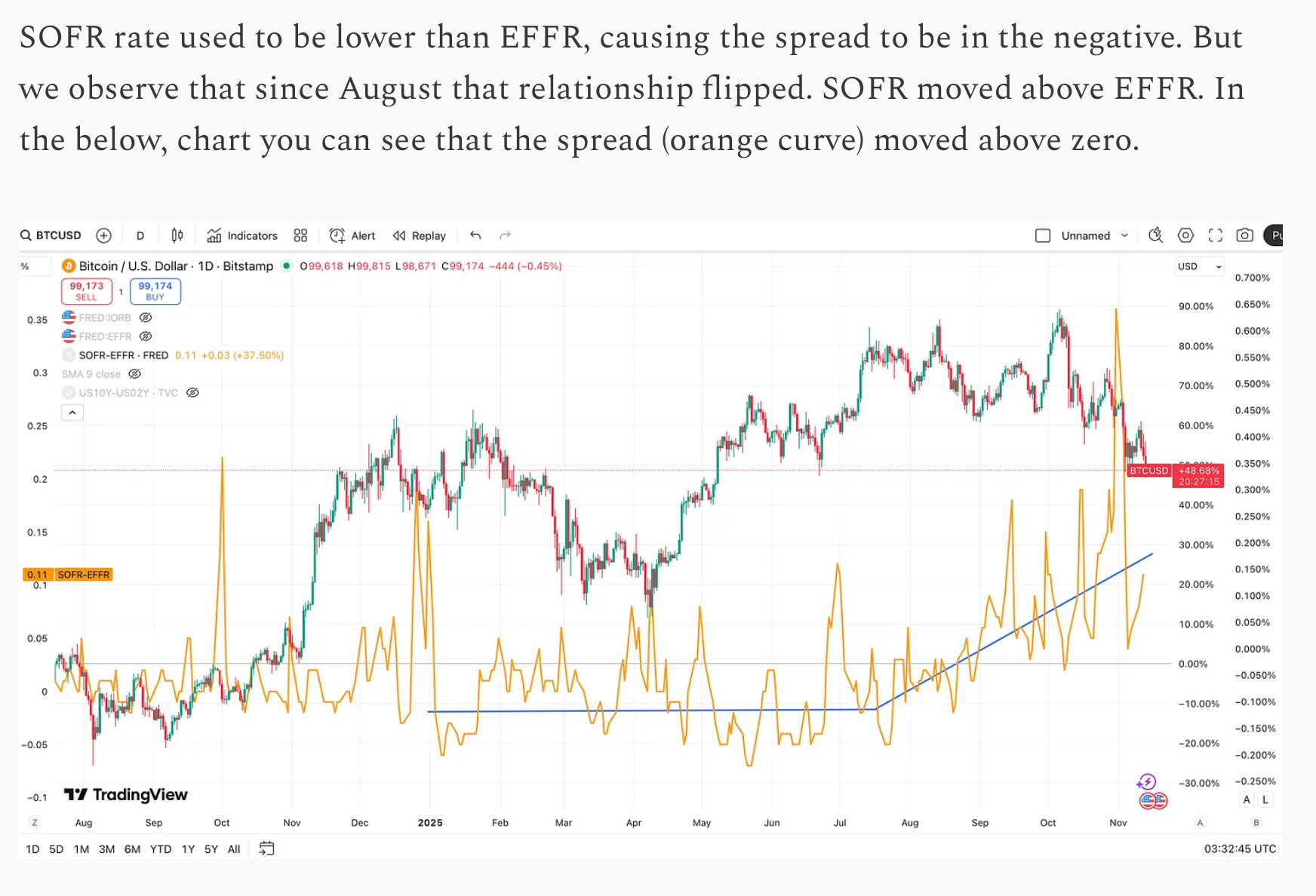
In that earlier piece, I focused on the idea that Bitcoin has become deeply tied to the global liquidity cycle. When repo funding becomes strained, leverage gets pulled back, capital becomes more defensive, and highly liquid risk assets are often the first to be sold. Bitcoin fit that pattern.
In this article, I return to that same critical metric. I revisit SOFR, the SOFR–EFFR spread, and what they continue to reveal about liquidity conditions, market stress, and the macro forces shaping Bitcoin’s next move.
Then I will discuss the anatomy of the price chart and how it has been moving recently from a qualitative standpoint.
Next, I highlight an interesting inflection in futures positioning.
And finally, I revisit the momentum model to quantify the momentum and the likely direction of the price from here.
1. Macro: Funding Stress Is Stabilizing
The SOFR–EFFR spread remains one of the most useful windows into short-term liquidity conditions. SOFR reflects the cost of secured overnight borrowing against Treasury collateral in the repo market, while EFFR reflects unsecured overnight interbank funding. Under normal conditions, SOFR tends to sit below EFFR because secured borrowing should generally be cheaper than unsecured borrowing. When that relationship flips, and SOFR moves above EFFR, it is often a sign that something is wrong in the funding system. Usually, that means collateral scarcity, strained repo conditions, or broader liquidity stress. For a refresher on the SOFR-EFFR spread, see the appendix.
That was exactly the signal we highlighted in November. At the time, the spread was elevated and unstable. It repeatedly spiked higher, pointing to real strain in funding markets. That behavior matched the broader selloff across liquidity-sensitive assets and helped explain why Bitcoin came under pressure. It was a funding-driven macro squeeze.
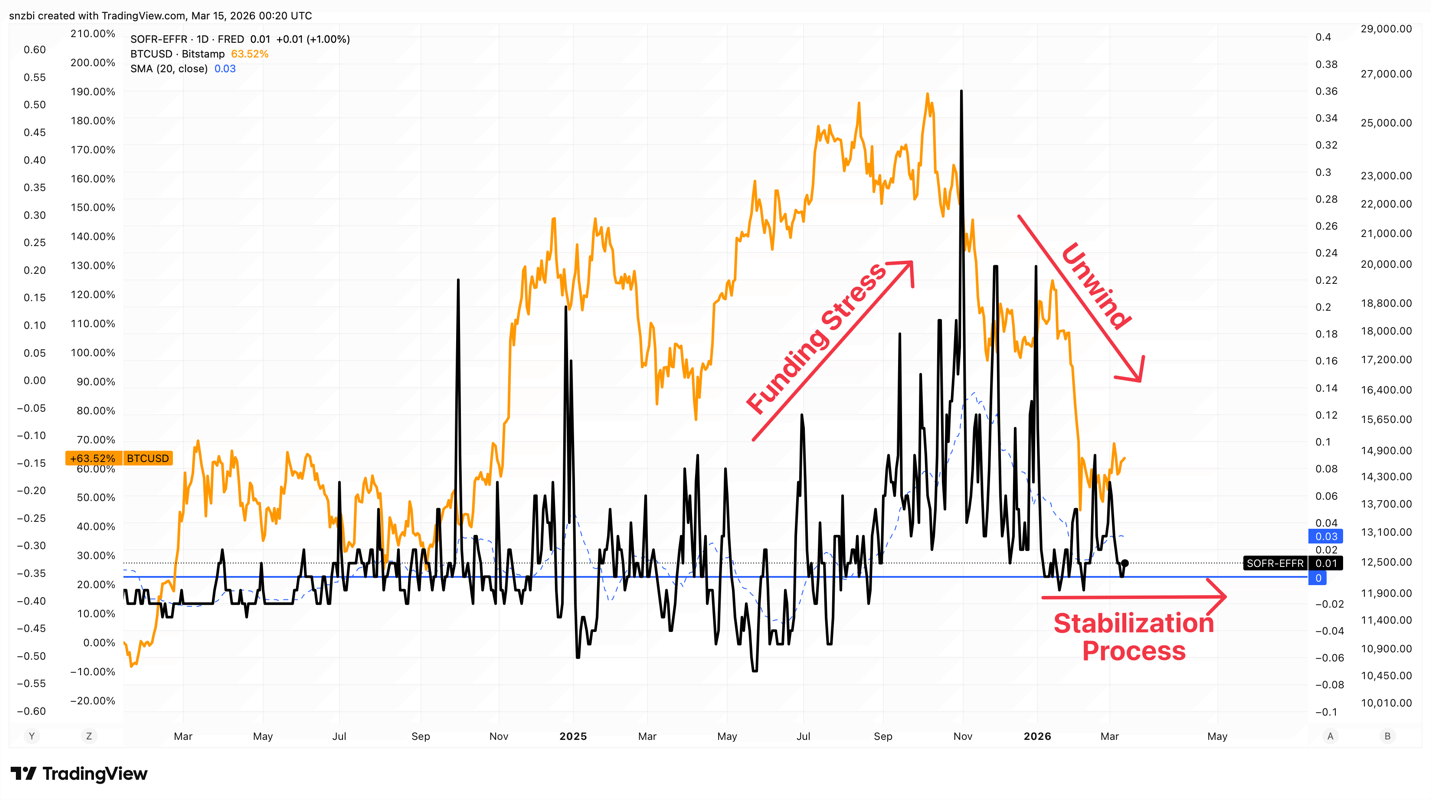
The chart helps clarify that sequence. The black line is the SOFR–EFFR spread, and the orange line is Bitcoin. What stands out is that the most violent phase of funding stress now appears to be behind us. The spread had repeatedly surged higher, signaling stress in short-term funding markets and reinforcing the idea that Bitcoin’s earlier weakness was part of a broader liquidity squeeze rather than an isolated crypto event. Those spikes reflected unstable funding conditions, where pressure in repo markets was strong enough to push the secured rate above where it would normally trade relative to federal funds.
What is changing now is not just the level of the spread, but its stability. Instead of continuing to make extreme upside moves, it has started to unwind and compress back toward a much narrower range.
That does not mean liquidity is fully repaired. It does, however, suggest that the most acute phase of the stress is fading. In other words, the system appears to be moving from disruption toward stabilization.
A market under worsening funding stress usually produces repeated forced deleveraging, erratic price action, and continued pressure on liquidity-sensitive assets like Bitcoin. But once the spread stops exploding higher and begins to settle, it often signals that the forced-liquidation phase is losing momentum. The damage from the squeeze may still be working through markets, but the plumbing is no longer deteriorating at the same pace.
For Bitcoin, as a liquidity-sensitive asset, this is an important shift. If the November regime was defined by rising funding stress, the current regime looks more like a stabilization process. This backdrop does reduce the probability that Bitcoin will face further liquidity squeezes.
This is why I still view SOFR and the SOFR–EFFR spread as critical metrics. They tell us whether the macro environment is becoming more hostile or less hostile to risk assets. Back in November, they helped explain the selloff. Now, they may be among the earliest indicators that the worst phase of that stress is passing.
2. Price Behavior: The Six Phases
The price chart explains how that funding stress actually expressed itself in Bitcoin. The move can be broken into six distinct phases, each with its own character. Taken together, they describe the full arc from late-stage bullish expansion to washout and the early signs of stabilization.
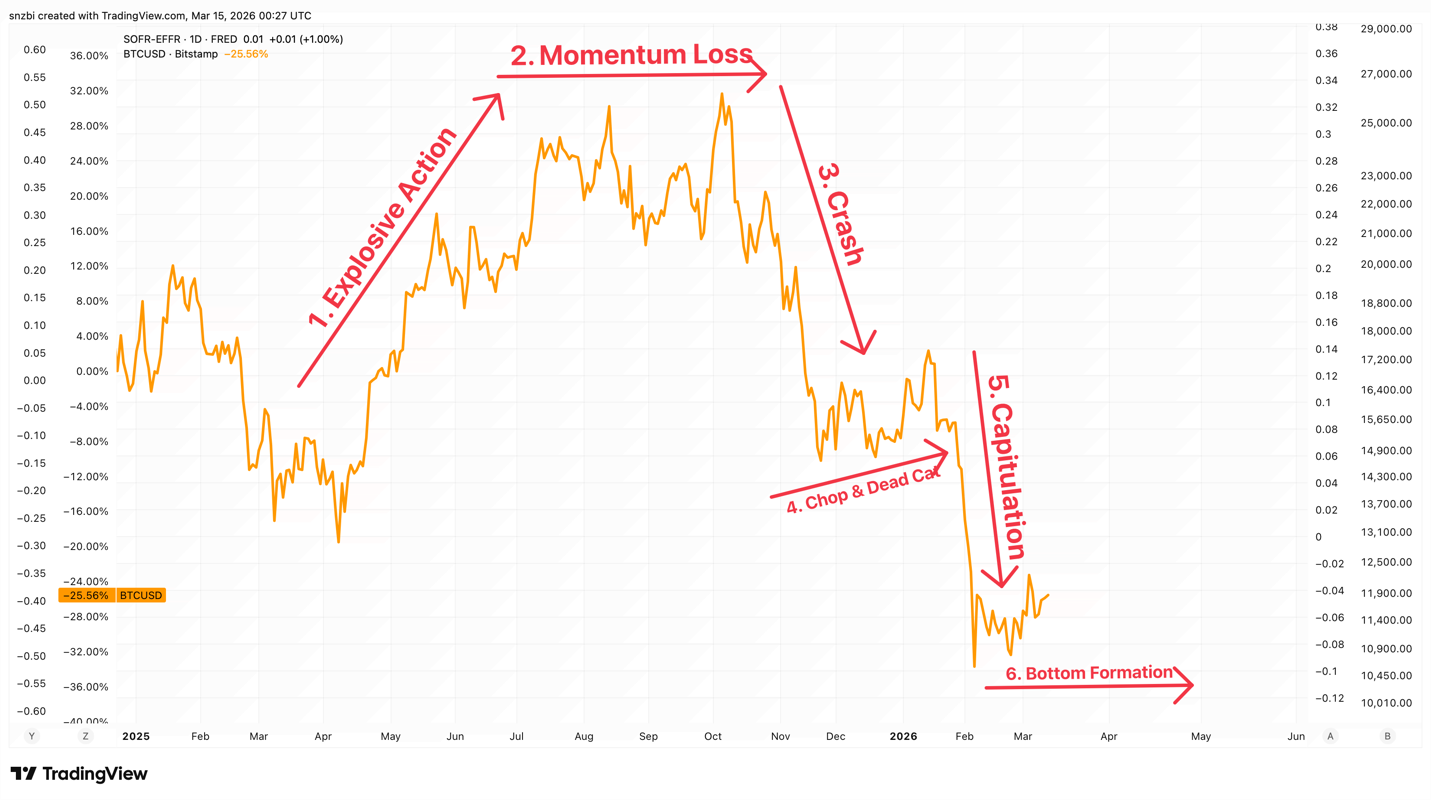
1. Explosive action. This was the impulsive upside leg where momentum, sentiment, and positioning all moved in the same direction. Price advanced quickly, dips remained shallow, and buyers stayed in control. These are the kinds of moves that create confidence because the market appears able to absorb everything.
But they also bring the “god candle,” “1M this year,” and “basically no risk” guys onto the scene and create fragility.
Once a rally becomes extended, it depends on a continued flow of fresh demand which gets harder and harder to sustain.
2. Momentum loss. This is usually the earliest sign that a regime is changing. Price may still appear elevated, and in some cases, it can even retest highs, but the internal energy of the move begins to fade. Breakouts become weaker, follow-through deteriorates, and the market starts needing more effort to achieve less progress. This is often where the strongest hands begin to notice the shift before the broader market fully reacts.
3. First leg of the crash. Once momentum had rolled over and the macro backdrop deteriorated, price broke sharply lower. This is the stage where the market moves from vulnerability to actual damage. Selling accelerates and the decline becomes more disorderly.
In Bitcoin, this kind of phase is usually amplified by its role as a highly liquid risk asset. When broader liquidity stress hits, Bitcoin often becomes something that can be sold quickly.
4. Chop and the dead cat bounce. After the first violent leg lower, markets often do not go straight into recovery. Instead, they enter an unstable middle zone driven by a premature “crash is over” call. Price bounces, but the rebounds fail to build real trend. Rather, surprised participants find it a good place to sell and get out. This creates a frustrating environment of false starts, local rebounds, and renewed weakness. It wears down both bulls and bears.
5. Final capitulation. This is the final emotional flush, the point where early selling leads to more forced selling and remaining optimism breaks down. Capitulation tends to be sharp and ugly as it reflects the last wave of surrender.
This is often where the market finally clears out weak hands, but it is also the phase that feels the worst in real time because sentiment becomes overwhelmingly negative just as the decline reaches its most compressed form.
6. Bottom formation. Then the market stops behaving like it is in free fall, even if it has not yet turned clearly bullish.
Bottoms are usually a process, not a moment.
Volatility begins to compress, the pace of deterioration slows, and price starts to stabilize in a range rather than continue cascading lower. The key feature here is stabilization. The market begins to absorb bad news more effectively, and that often marks the earliest stage of a regime transition.
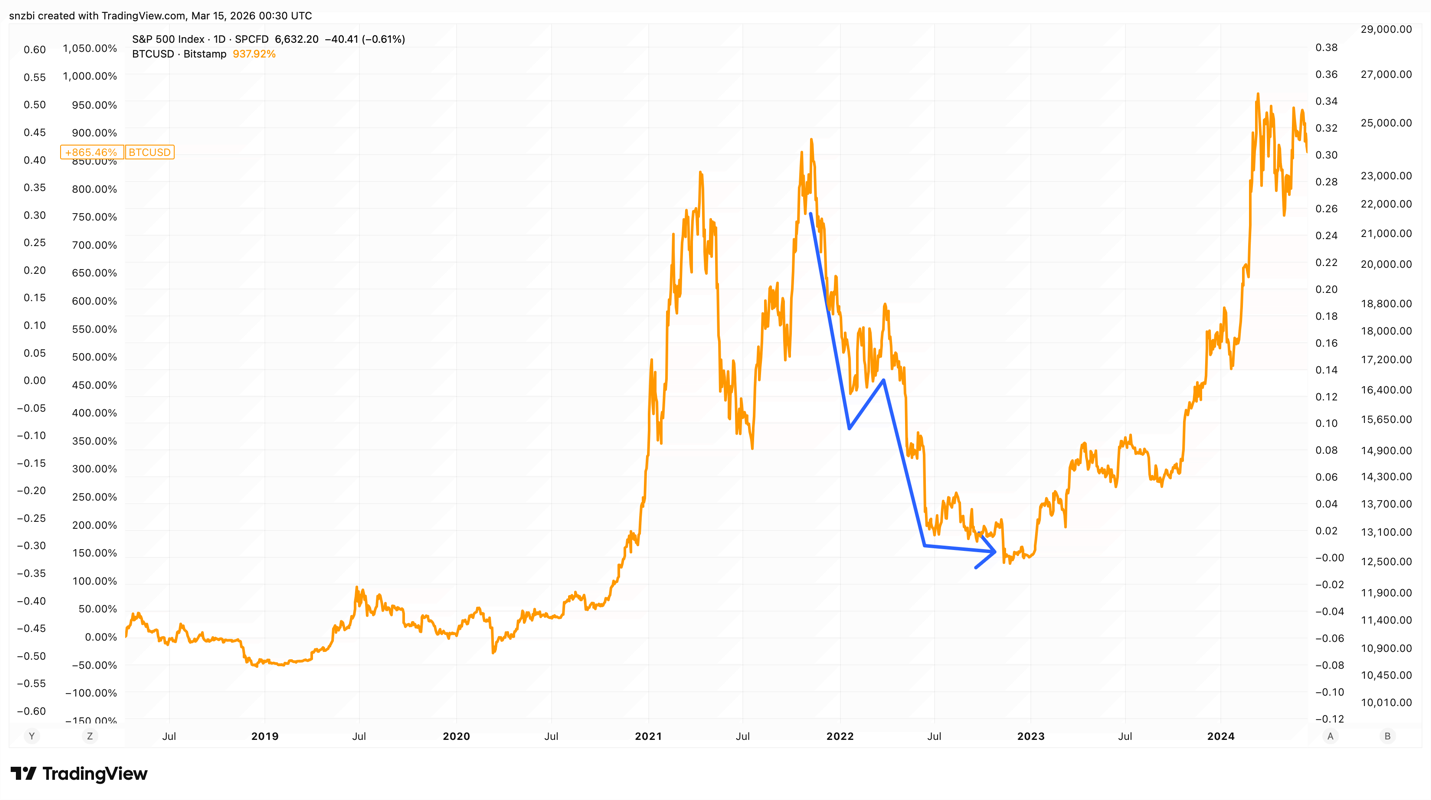
What makes the current setup more notable is that this pattern looks very similar to the prior cycle. In the earlier cycle, Bitcoin also moved through a sequence of upside expansion, momentum loss, sharp breakdown, unstable chop, capitulation, and eventual bottoming. The exact path was not identical, but the internal structure was remarkably close. Markets often do not repeat exactly, but they do rhyme in process.
If the price structure is beginning to resemble a late-stage correction, the next question is whether positioning data confirms that interpretation.
3. Futures Market: Funding Rate and What It Is Saying Now
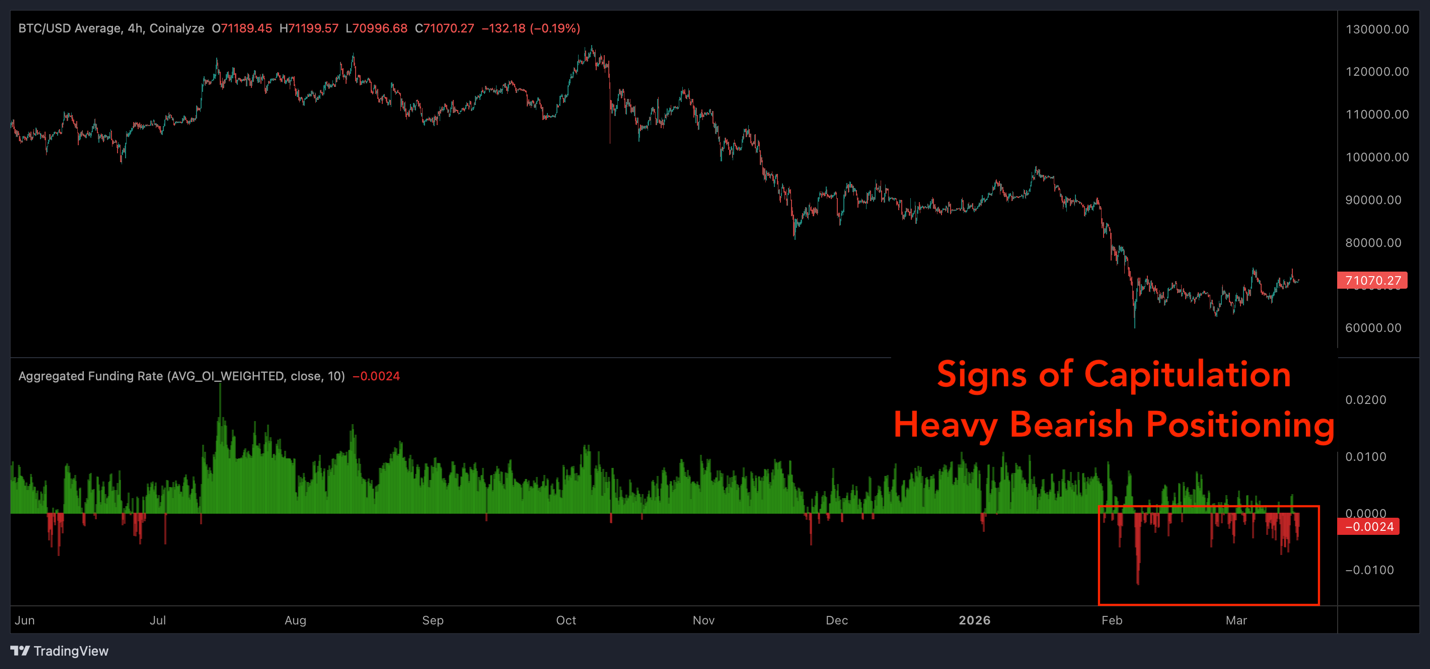
Another part of the market I always pay close attention to is futures positioning, especially the funding rate. We have written in past articles about the importance of funding rates because they are one of the best short-term indicators in Bitcoin. They are not perfect, and they do not tell you everything about the broader cycle, but they are extremely useful for understanding where speculative positioning has become too stretched in one direction.
Funding rate matters because it tells us who is paying whom in the perpetual futures market. When funding is positive, longs are paying shorts, which usually means bullish positioning is crowded and traders are willing to pay to maintain upside exposure. When funding turns negative, the opposite is true; shorts are paying longs, meaning bearish positioning has become dominant, and traders are leaning heavily to the downside.
That is why the current pattern is interesting.
It shows a sustained period of negative funding rather than a brief dip. That is a meaningful change. It tells us that bearish positioning has remained persistent for some time and that the speculative side of the market has become heavily skewed toward expecting lower prices. In plain terms, there has been a broad willingness among futures traders to keep pressing the short side.
This kind of setup often appears in the later stages of a corrective process. By the time funding stays negative for an extended period, a lot of fast money has already shifted bearish. The market is no longer dealing with complacent longs that still need to be flushed out. Instead, it is dealing with a futures complex where pessimism has already become embedded in positioning. That is why persistent negative funding is often associated with signs of capitulation and heavy bearish positioning rather than the beginning of a fresh euphoric decline.
Negative futures funding can take some time to work. Absent a new fundamental shock, it does say that the odds of further downside are highly reduced, because most speculative money is already betting bearish and not much more sell pressure is left.
Simply put, roughly everyone who wanted to be short already is.
But that does not necessarily mean immediate resurgence of demand. First these shorts need to cover.
That brings us to momentum, which helps determine whether stabilization is merely passive or whether the market is beginning to regain internal strength.
Now, let’s briefly look at our momentum model.
4. Momentum Model: Improving, But Not There Yet
The final piece of the puzzle is momentum.
