
Bitcoin Valuation Models Point to the Extreme Cold Zone: Quantile & Power Law Model Updates
Quantile Model, Power Law Model, VPLI review

Introduction
It has been a while since we last checked in on the long-term valuation models, but now more and more interesting signals are emerging. When markets turn choppy and narratives worsens, pessimistic headlines proliferate, but long-term signals often get cleaner. In this update, we look at two complementary frameworks that are designed to answer one core question: where is Bitcoin trading relative to its long-run trend, and what does that imply about risk and opportunity?
First, we revisit the quantile regression model, which maps Bitcoin’s price to a distribution of historical regimes, ranging from “cold” bear-market zones to “hot” bubble zones. Then we cross-check that message using the power law model, which focuses on whether price is trading above or below the adoption trend line. Finally, we summarize the signal with the Volatility-Adjusted Power Law Index (VPLI), which adjusts deviations from trend for the volatility backdrop, so we can compare today’s dislocation to earlier cycles more fairly.
Quantile Model
The quantile model is built using quantile regression on log(Bitcoin price) against log(time since inception). Using logs matters because Bitcoin’s growth has been closer to a power-law style trend than a straight line, and the log–log setup turns that long-run curve into something the model can fit cleanly. Instead of producing just one “best-fit” path like ordinary regression would, quantile regression estimates multiple bands, think of them as percentile lanes of where price tends to sit relative to its long-term adoption curve. Those bands can be interpreted as valuation and risk regimes. Lower bands reflect historically depressed pricing, with low exuberance and high pessimism, while upper bands reflect historically stretched pricing, with high exuberance, crowding, and late-cycle behavior.
Long-term view (full history)
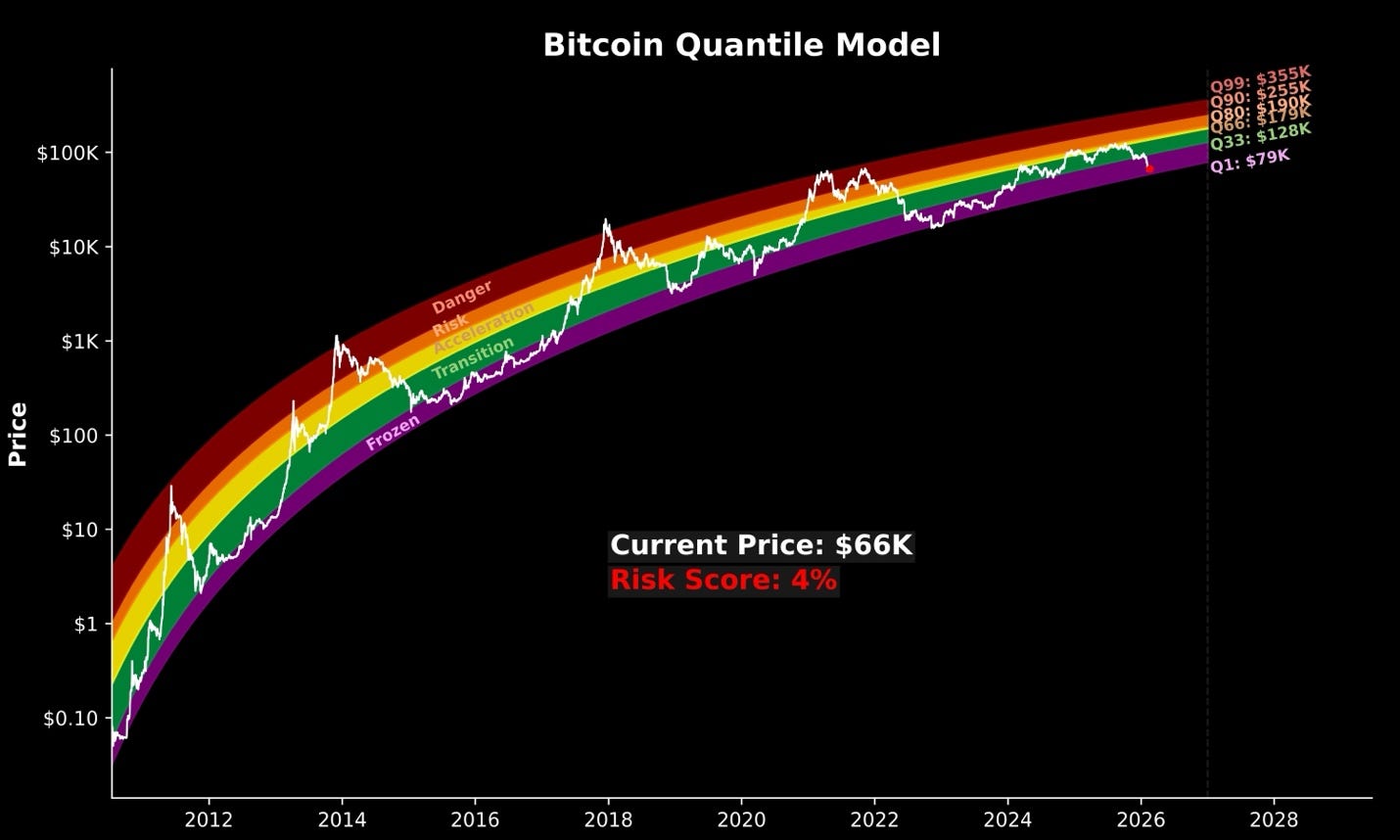
The long-term chart shows how well Bitcoin’s major cycles have tended to oscillate within these bands. In prior cycles, price eventually pushed into extreme overheated territory, the upper quantiles, where upside became increasingly fragile, meaning the market was pricing in near-perfect conditions and demand momentum was doing most of the work. In the current cycle, the market peaked earlier, struggled to sustain the kind of upside acceleration needed to break into the true bubble zone, and then mean-reverted downward back toward the lower bands.
That shift can be explained by several plausible headwinds, and it’s probably not just one thing:
Demand absorption via paper Bitcoin exposure: As more investors access Bitcoin through paper products and packaged derivatives, marginal flows can express themselves differently, sometimes more orderly, which may reduce the violent reflexivity you used to see in late-cycle blow-offs. This may dampen the upside and change the shape of the cycle, smoothing some extremes.
Narrative competition and capital rotation: The AI trade has been an unusually dominant magnet for attention and capital, and narratives matter in speculative markets because they influence who shows up at the margin and how aggressively they allocate.
Macro and liquidity conditions: Bitcoin is still heavily influenced by global liquidity and risk appetite. If liquidity is contracting or not expanding explosively, you can get crashes and chops rather than mania.
Quantum computing gets brought up a lot as a risk narrative, but in practice, it’s unlikely to be the main driver of cycle structure right now. Even if you take the concern seriously, it’s a longer-horizon tail risk story, not the kind of thing that cleanly explains why a cycle fails to go full bubble today.
Zoomed-in view (where we are now)
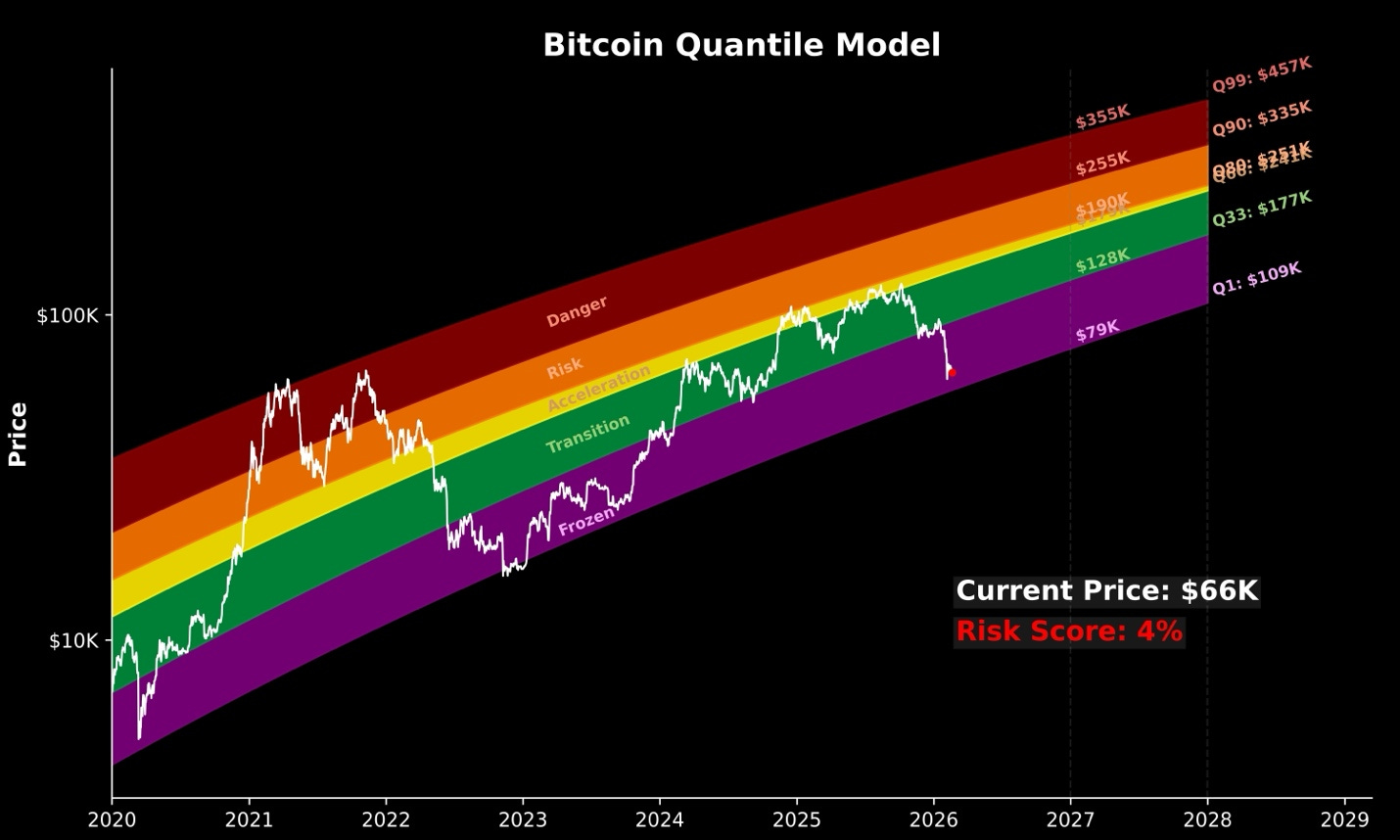
On the closer view, Bitcoin is around $66K, and the model’s risk score is about 4%. Interpreting that plainly, relative to this long-term trend framework, Bitcoin has been cheaper than this level only about 4% of the time across its observable history, as measured by this model’s placement along the quantile bands. That is not a statement about tomorrow’s price action, it is a statement about historical positioning. By this yardstick, we are sitting in a region that has usually been associated with depressed valuation and lower long-run risk, not no risk, just lower in the context of cycle history.
Right now, price is sitting in the purple band, which has historically lined up with bear-market low zones, periods where downside tends to slow, sentiment tends to be washed out, and the market starts building the base for the next advance. The bottom of that band is around $58K. If price were there, the model would place Bitcoin around the 1st percentile of historical cheapness, meaning Bitcoin would have spent only about 1% of its time at a lower valuation relative to trend. Put differently, within this framework, that area acts like a highly defensible floor, not because it cannot break, but because it would represent an unusually cheap deviation from the long-term path Bitcoin has respected for most of its life.
One key clarification, this model is not a short-term timing tool. It does not tell you whether next week is up or down. What it does well is give you a cycle-aware map, where price sits relative to its long-run adoption trend, and how stretched or compressed the market looks compared to history. That is exactly why a 4% risk score reading matters, it is about recognizing when the market is priced like fear and fatigue, not like euphoria.
Power Law Model and VPLI
It is useful to cross-check the quantile read with a second framework, the power law model. If the quantile model tells us where price sits inside a historical distribution of “hot vs cold” regimes, the power law model answers a simpler question: how is Bitcoin currently trading relative to its long-run adoption trend?
